When we picture a multi-adventure school trip, we normally imagine a large number of sporting activities in a mountain setting. This is a curious thing, because although multi-adventure activities are not exclusive to or dependent on a mountain landscape, we tend to associate them with one. Perhaps because the mountains do not offer just a single multi-adventure option, but a vast number of possibilities. In fact, many of the multi-adventure activities proposed for this environment are grouped under the unifying name of mountaineering. By this term we tend to mean any physical activity carried out in the mountains, although in a more specific sense it refers to the act of ascending peaks. This «walk in nature» represents one of the first multi-adventure activities undertaken by human beings, and the foundation from which all the others have developed.
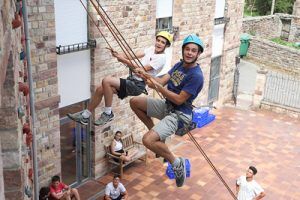
A large proportion of the multi-adventure activities offered on school trips revolve around rope-based activities. Climbing is one such activity. This activity and its variants have become one of the main attractions of school trips. Traditional climbing involves traversing faces with a steep gradient, normally with the support of ropes and harnesses. Climbing is an increasingly popular sport that is gaining more and more enthusiasts, and it holds great appeal for young people. The sensation of ascending a natural rock face is unique. It encourages concentration and decision-making, as well as a greater awareness of one’s own psychomotor skills and increased confidence in them. From climbing, various other multi-adventure activity options have also developed, based on the same principle.
Multi-Adventure School Trip Activities: Ropes Course
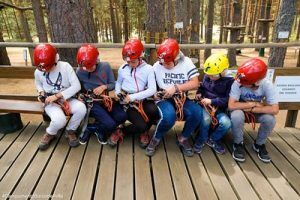
The success of climbing as a multi-adventure activity on school trips has led to the development of various themed parks centred on this activity. One such example is what are known as ropes courses. A ropes course is a themed park in which a variety of multi-adventure and mountain-related activities take place. They are usually situated in natural surroundings, typically in forests or wooded areas, which is why this activity is often referred to as arborism. This is because the trees themselves are integrated into the activity and serve as a base for several similar activities. One of the highlights is the zip line. By means of a system of pulleys, ropes and counterweights, the participant is transported — secured by a harness attached to a rope — from one point to another above the ground.
The zip line is one of the main activities in a ropes course, but by no means the only one. Many others are defined as crossings, and involve moving from one tree to another by means of various rope systems. One such crossing is the bear walk, which features a rope the participant walks along and two higher ropes to hold with their hands. Another is the monkey crossing, in which the participant climbs along ropes as if they were one of those primates. In this way, ropes and climbing become a form of sport and contact with nature that makes a multi-adventure school trip a truly unique experience. Today, ropes courses and adventure parks can be found in almost every region of Spain.
Multi-Adventure School Trip Activities: Canyoning and Rafting
The multi-adventure activities on school trips that take place in a mountain environment do not always have to occur in dry surroundings. The mountain environment also offers a wide range of water-based activity options, making use of reservoirs and rivers. As a result, multi-adventure activities can also be carried out in these watery settings. One of the most popular is canyoning. This sport involves travelling through various watercourses and bodies of water, including jumping into plunge pools and passing through caves and canyons. For this activity, participants must wear a wetsuit and a helmet, ensuring the sport is carried out with maximum safety. These routes, undertaken between water and mountain, are led by expert professional guides who specialise in this sport.
Another activity with similar characteristics, and a regular feature on multi-adventure school trips, is rafting. This activity also involves descending a river, but in this case in a boat. Given that the route passes through areas of considerable depth or sections with rapids, the vessel is a wide, specially designed craft capable of navigating these zones. Participants, wearing a life jacket, wetsuit and helmet, sit inside the boat. Each person holds a paddle which, under the guidance of the instructor on board, they use to correct the course. In this way, rafting is an activity in which participants practise and see how their own effort is rewarded and put to the service of achieving a shared goal.
Multi-Adventure School Trips
You can find all the information about how our multi-adventure school trips work on the following pages: