In this guide we have already covered why you should organise your school trip to Valencia, where to stay there, and which activities are best so you do not miss a thing in the city. In this article, we bring you the definitive and essential list of interesting places to discover on your visit to Valencia. Make sure you do not miss anything, and your students will carry a wonderful memory of their school trip with them for years to come!
Valencia has managed to preserve its old quarter perfectly, blending it with its most modern neighbourhoods and buildings without any visual clash that might disrupt the harmony of the city. As a recommendation, one of the best times to visit Valencia is spring — both for the explosion of colour and life in the city, and for the chance to experience first-hand one of the most celebrated national festivals: Las Fallas.
What places should you visit in Valencia in the urban area?
Valencia is a perfectly sized city to visit over a long weekend. One of the great advantages of the city is that, given its dimensions and the fact that the urban centre is concentrated in a small area, it is possible to visit all the monuments on foot with only short distances between them. These are the places you should see on your visit to Valencia in the urban area:
Oceanogràfic
The Oceanogràfic, set within the complex of the City of Arts and Sciences, is the largest aquarium in Europe, reproducing the world’s most important marine ecosystems. For groups of Primary, Secondary, and Sixth Form students, it can be an entertaining and standout visit within your school trip to Valencia.
City of Arts and Sciences
This controversial work by the famous architect Calatrava is one of the most notable visits in the city of Valencia. You may love it or not (it has its detractors and supporters all across Spain), but what is certain is that a visit to the museum housed within this building is an unmissable activity in your school trip itinerary.
Plaza del Ayuntamiento and Plaza de la Virgen
The first thing you encounter upon entering the square is the grand white façade of the Casa Consistorial, the seat of Valencia City Council. The Casa Consistorial was built between 1758 and 1763 in a blend of styles ranging from the original Neoclassical to Neo-Baroque, passing through Neo-Renaissance. Opposite it stands the former Post and Telegraph building. At the centre of the square is a lovely circular fountain. The explosions of the petards set off on the days of the mascletà take place in this main square, when tens of thousands of Valencians and tourists from all over the world come to experience the Fallas fireworks display up close.
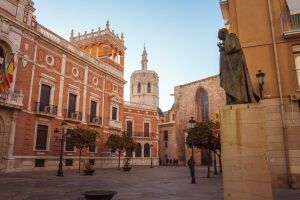
Very close by is the Plaza de la Virgen, another beautiful square surrounded by some of the most monumental buildings: the Cathedral of Santa María, the Basilica of the Virgin of the Forsaken (Basílica de la Virgen de los Desamparados), and the Palace of the Generalitat.
Central Market
Valencia’s Central Market is a feast for the senses — with a lively, bustling atmosphere, it is a must-see when visiting the city. The finest produce from the Mediterranean Sea and the Valencian market garden is sold here every day. Many of the city’s best restaurants source their ingredients here.
La Lonja de la Seda
Very close to the Central Market stands the Lonja de la Seda, or Silk Exchange — declared a UNESCO World Heritage Site (in 1996) and built between 1482 and 1548. The Lonja de la Seda is a testament to the economic power of Valencia in the 15th century, when the city experienced its own particular Golden Age.
Bioparc Valencia
If you think Bioparc Valencia is just another traditional zoo, you are mistaken. It is an educational centre where animals are cared for by highly skilled professionals in their respective natural habitats: savanna, wetlands, equatorial forest, and Madagascar. Bioparc also carries out important conservation work, helping to recover endangered species.
The Ruzafa neighbourhood
Ruzafa is Valencia’s trendiest neighbourhood. A district where creativity, leisure options and independent shops, and the combination of fashion and tradition are its main virtues. Discover it and add it to your itinerary — it will be the unexpected highlight of your school trip!
What places should you discover on your visit to Valencia along the coast?
Another great advantage of Valencia is that, being a coastal city, it allows you to combine urban activities with the beach — something students love when enjoying their school trip. Here is what to discover along the coast on your visit to Valencia:
Malvarrosa Beach
Valencia’s main urban beach, where you can take part in all kinds of water sports.
Maritime Promenade
Full of life and people, Valencia’s Maritime Promenade is an excellent option to visit after a long day at the beach — browsing the stalls for souvenirs or stopping for a drink at one of the many bars and terraces in the area.
Albufera Natural Park
The Albufera de Valencia is a coastal lagoon surrounded by rice paddies and an important stop for migratory birds. Its ecological value is very great, as numerous and valuable endangered bird species make their home here.
Guide to your school trip to Valencia
Discover much more about Valencia and how to plan your school trip with the rest of our guide: activities, accommodation, key monuments, and more:
- Organise your school trip to Valencia
- Where to stay on your school trip to Valencia?
- 10 must-see places to visit in Valencia
- Discover Valencia in 2 days
- What to do on your trip to Valencia so you do not miss a thing?
- Main cultural festivals in Valencia: Las Fallas
For more information about the possibilities for your school trip to Valencia, you can contact us at info@natuaventura.com or by calling 91 714 06 36.