Doñana is a protected area of more than 120,000 hectares divided between the National Park and the Natural Park. These lands constitute the most important wetland in Europe. Its richness and ecological value have led to the Doñana National Park being recognised as a UNESCO World Heritage Site and Biosphere Reserve. Discover here a possible 3-day itinerary — complete and packed with all kinds of activities — for your school leaving trip to Doñana. It will take you not only through this imposing park, but also to all the important spots located in the surrounding area.
Over these days you will discover the marshes, spot migratory birds, explore the mobile dunes of Doñana, its rich fauna and flora, the most iconic villages in the area, the Columbian Sites essential for understanding the Discovery of the Americas, and the stunning beaches of the Atlantic coastline. Immerse yourself in Andalusian culture, its gastronomy, traditions and landscapes on this 3-day route for your school leaving trip to Doñana.
Day 1. Visit to Doñana National Park and the village of El Rocío
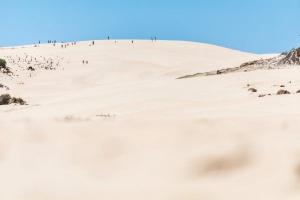
We begin the itinerary in Matalascañas, with a 4×4 route that takes us into the park. The dunes appear almost immediately, and the vehicle can bounce along for quite a stretch. The famous mobile dunes of Doñana can reach up to 30 metres in height. Here you will be able to spot all manner of wildlife, guided by your tour guide, and will learn how the dunes are formed and the importance of this great Nature Reserve, unique in Spain. You will be able to walk through the designated areas and admire the beauty of its landscapes and the sense of peace that pervades this protected environment. And if you are very lucky, you might even spot an Iberian lynx — so keep your eyes peeled!
Later, once the guided tour of Doñana is complete, we head towards the famous village of El Rocío. Unpaved streets that surrender to the Virgin of El Rocío, whose enormous pilgrimage is known the world over. But El Rocío is more than a pilgrimage, and it is best visited in spring, ideally on a Sunday, when the locals take their horses out for a ride through the village. A walk along the edge of the marshes while watching hundreds of flamingos and other waterbirds is also a must.
Day 2. Visit to the Columbian Sites
This visit is a magnificent opportunity for an open-air History lesson, discovering at first hand the place from which Christopher Columbus’s three caravels set sail. Arriving in Palos de la Frontera, the seafaring and conquering atmosphere is immediately apparent, with large wooden ships filling its impressive harbour. It is a visit declared a Site of Historic and Artistic Interest that spans the municipalities of Moguer and Palos de la Frontera. The most interesting places to visit in this area are:
-
Muelle de las Carabelas (Caravels Quay)
Here we can see the replicas of the caravels — the Pinta, the Niña and the Santa María — built in 1992 to mark the 500th anniversary of the Discovery of the Americas. Along this promenade we will also find a recreation of a harbour district of the period, and a settlement like the one the Spanish sailors found upon their arrival in the New World.
-
Monasterio de La Rábida
The Monastery of Santa María de La Rábida was of vital importance in the history of the Discovery of the Americas, as it was there, sheltered by the Franciscan friars, that Christopher Columbus planned his voyage before setting sail on the caravels.
-
Parque Botánico José Celestino Mutis
Opened in 1993 to commemorate the 500th anniversary of the return to Palos de la Frontera of the expedition that carried out the Discovery of the Americas. On our walk through the park we discover an extraordinarily wide variety of flora from every continent.
-
Monumento a la Fe Descubridora
A colossal statue standing some 37 metres tall, donated by the United States, literally «as an expression of friendship to the Nation».
Day 3. A day at the beach and water sports at Isla Canela
We round off this 3-day itinerary for your school leaving trip to Doñana by reserving the final day for pure enjoyment and rest at the beach and nearby villages. Continuing through Huelva, we recommend visiting Isla Canela beach, where you can try all kinds of water sports: kayaking, sailing, kitesurfing, windsurfing… you can even try a SUP Yoga class (Stand Up Paddleboarding) and test your balance on the board! The seafront promenade runs from the Punta del Moral jetty to Isla Canela and features a cycle lane so you can bring out the cyclist in you.
Very close by is Isla Cristina, where we can attend the fascinating fish auction at the fish market (this time, the open-air lesson is in Geography) and see first-hand everything that entails and the daily routine involved in supplying the product to different points across the peninsula. Today Isla Cristina’s fishing port is the number one in Spain alongside Vigo’s, so watching the produce arrive by boat right through to its sale can make for a very interesting activity on the school leaving trip.
Finally, in Punta Umbría we find 12 kilometres of beach and a seafaring village with wide avenues and a charming, well-kept old town offering a wide range of bars and shops. Here we will have the chance to sample Huelva’s typical tapas, with fish and seafood always the star of the show.
Guide to organising your school leaving trip to Doñana
If you are thinking of organising your school leaving trip to Doñana, you have come to the right place, because this guide brings you all the information you need before and during the trip: accommodation, gastronomy, transport, possible itineraries, excursions…
Plan your school trip to Doñana with Natuaventura — we offer you as many possibilities as you can imagine, and a team of activity leaders with more than 15 years of experience in school leaving trips. Do not miss a single detail!
- How to organise your school leaving trip to Doñana
- Multi-adventure activities in Doñana
- School leaving trip to Doñana in 3 days
- Where to stay on your school leaving trip to Doñana
- 10 places to visit on your school leaving trip to Doñana
For more information about the possibilities for your school leaving trip to Doñana, or any other destination, you can contact us at info@natuaventura.com or by calling 91 714 06 36.