If you have decided to organise your school trip to Cuenca, you will need to plan the priority visits and essential activities to ensure the trip runs smoothly and leaves a lasting impression on the group. Planning a school trip to places of historical, cultural, or natural interest allows the group of pupils to enjoy «practical lessons» away from the classroom, in an environment where they focus their attention more readily and their curiosity grows freely. What to do on your school trip to Cuenca? Discover every corner of this region with the practical guide we have put together for you.
The Historic City of Cuenca has been on the UNESCO World Heritage List since 1996. Its outstanding location, perched on a hillside and enclosed by the gorges of the rivers Huécar and Júcar, was just as important as the heritage value of the historic centre when Cuenca was designated a World Heritage Site. But it is not only the city of Cuenca that hides great landscapes; throughout the Serranía you can discover magical places such as the Enchanted City.
Visit to the city of Cuenca
Below we list all the places you must not miss on your visit to the city:
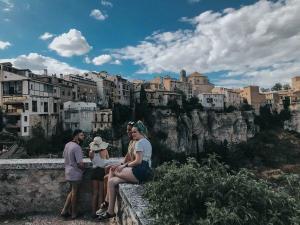
- Casas Colgadas (Hanging Houses), also known as Casas Voladas or Casas del Rey, are a group of civil buildings named after the way they were built over large balconies, jutting out over the high rocky cornice of the gorge of the river Huécar.
- Cuenca Cathedral: built in the early 12th century in a distinctive blend of Gothic and Norman styles, it is the most prominent building on the Plaza Mayor.
- San Pablo Bridge: in order to bridge the great difference in height and connect the convent of San Pablo with the city, the San Pablo Bridge was built in the 16th century, originally in stone. After its collapse, the bridge we can see today was erected in 1902. It is an impressive iron and timber structure approximately 100 metres long with a span of around 60 metres.
- Torre de Mangana is a building in the Spanish city of Cuenca with the status of an asset of cultural interest. It has undergone several renovations throughout its history.
- Hoz del Júcar and Hoz del Huécar. Strolling along the banks of both rivers is a real pleasure after a tour of Cuenca’s monuments. Two impressive rocky walls rise up on either side of the river course. From the top, numerous buildings that form part of the Old Town peer over the edge, in contrast with the many orchards still in use along the riverbank.
- Castle Ruins, City Walls, and Arco de Bezudo: remains of the walls and an arch from what was once an Arab fortress perched at the top of the city. Little remains of the old fortress; one of the best-preserved sections is a beautiful semicircular arch at the entrance gate, known as the Arco de Bezudo.
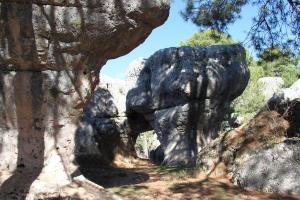
- The Enchanted City: a natural landscape of limestone rock formations shaped over thousands of years. Pupils will have great fun spotting shapes in the rocks, which evoke recognisable silhouettes of animals, people, and objects.
Other important tourist attractions you should visit on your school trip to Cuenca
- Mirador del Cerro del Socorro
- Iglesia de San Pedro
- Cristo del Pasadizo
- Los Ojos de la Mora
- Museo Fundación Antonio Pérez
Excursion to the Enchanted City
It is located in the village of Valdecabras, in the heart of the Natural Park of the Serranía de Cuenca, surrounded by vast pine forests. The Enchanted City is one of the most spectacular natural landscapes in our country, where you can learn about the geological process of karst formation and admire its extraordinary rock formations. For this reason, the Enchanted City was declared a Site of National Natural Interest in 1929.
At the end of the Cretaceous period, as a result of the Alpine orogeny, the sea retreated and the seabed — composed of limestone — emerged at the surface. Thousands of years of action by water, wind, and ice mean that today we can admire this impressive geological phenomenon, in which pupils will delight in a magical natural environment. The visit to the Enchanted City of Cuenca follows a circular route of approximately 3 kilometres. During the hour and a half that the visit takes, you can see a variety of rock formations to which the names of animals and objects have been given (the Ships, the Seal, the Slide, and so on).
The visit is a unique experience and a Geology lesson in the heart of nature, where primary and secondary school pupils can see for themselves the formations that rock, water, and wind create over millions of years. Complementary activities carried out outside the normally stricter environment of school encourage open-mindedness, focus pupils’ attention, and enrich the teacher’s lessons.
Practical guide to organising the school trip to Cuenca
Nothing beats recharging your batteries on a school trip with the whole class or year group. We know that organising and planning the entire trip — activities, excursions, and accommodation — is a burden that falls on the teachers. At Natuaventura we want to make it easier for you, and we have put together a comprehensive guide with all the information you need for your primary school, secondary school, or sixth-form trip to Cuenca. Keep reading!
- How to organise your school trip to Cuenca?
- What to visit on your school trip to Cuenca? (I)
- What to visit on your school trip to Cuenca? (II)
- Multiadventure activities on your school trip to Cuenca
For more information about all the school trips that Natuaventura organises to Cuenca, write to us at info@natuaventura.com or call 91 714 06 36.