What more complete, diverse and enjoyable natural space could we imagine than the beach? The coast is without doubt the top choice for groups organising their school trip, for numerous reasons. The first of these is the appeal it holds in terms of fun for the children. This is one of the main reasons why nature trips are so important. They demonstrate that total enjoyment is possible in settings where there are no elements such as video games, shopping centres or places specifically designed for play. Play can take place in a natural space like the beach or the sea itself, and is all the more powerful for being independent of props or physical elements to rely on. School beach trips show participants their capacity to enjoy themselves in natural spaces.
The beach allows visiting groups to get a glimpse of how a marine ecosystem works. This is one of the many types of ecosystems that children study in their natural science and biology classes. The beach is the perfect combination of a land environment and a marine one, where pupils on a school trip enjoy the harmony of both spaces. On any school trip, participants will usually have already visited the beach with their families. And for most of them it tends to be a place already associated with fun. School trips will only build on this and show them the many possibilities that coastal settings offer for activities and games. Below, we will go over this range of activities, as well as the safest practices for carrying them out with the greatest level of safety.
School beach trips: water sports activities
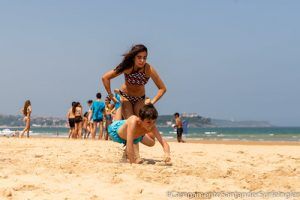
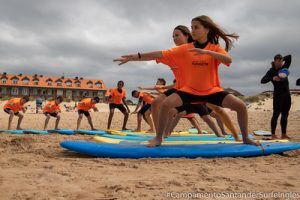
One of the advantages of school beach trips is the enormous number of activities they make available to participants. Water sports activities can be grouped under the concept of multi-adventure. Multi-adventure activities are a form of active tourism in which physical activity is carried out with a recreational objective in a natural setting. This connects directly with the idea behind school nature trips: enjoying and learning while doing activities in a natural environment. The beach allows groups to try activities such as surfing. This exciting sport captures the attention of young and old alike, and offers a sporting experience in the sea itself. It also comes in a wide variety of formats to be enjoyed individually or in a group: paddle surfing, windsurfing and kitesurfing.
In addition to surfing, school beach trips can include many other activities. Among them, canoeing stands out. This involves participants getting into canoes and paddling along the coastline, taking in the scenery viewed from the water. Canoeing involves practising an aerobic sport in the heart of the natural environment, which requires cooperation with fellow participants for it to go well. Another sport we can enjoy at the beach is sailing, which school trip groups find thrilling. It is usually their first experience of sailing a vessel of this kind, learning how to handle the sails and the rigging. Pedalo rides are also another group activity that can be enjoyed at the beach.
School beach trips: greater safety, greater fun
The main aim of school beach trips is to have fun in the natural environment. However, for both the school and the families there is one element that stands out for its great importance in these activities: safety. We are aware that every multi-adventure activity, as well as any trip involving minors, must have the necessary safety protocols in place to avoid any risk. Beach activities, by their very nature, require an extra level of safety. The sea is a changeable environment where every precaution counts, even when conditions are not extremely dangerous. For this reason, school trips must always have the guidance of a team of professional monitors who know how to manage these activities. It is the best way to offer peace of mind to the school and to families.
For a simple swim as much as for any activity, it is important to maintain safety protocols. If participants are in the water, there must always be responsible supervisors attending to them. Prior to entering, a series of codes and gestures have been established whose meaning has already been explained. In this way, if a piece of advice or an instruction needs to be communicated while in the water, the noise of the sea is no obstacle, since having a visual on the monitor means the message can be conveyed, guaranteeing safety. At all times, the instructions of the lifeguards and the professional multi-adventure activity teams must be respected and followed. In these activities, the instructors themselves will give us the advice needed to carry out the activity in complete safety. In this way, school beach trips can be carried out with full guarantees.
School trips in nature
At Natuaventura Ocio y Tiempo Libre we have been running all kinds of school trips for over 15 years. That is why, with our extensive experience, we make the following articles about school trips in nature available to you: