Getting to know Barcelona is not simply about visiting the monuments featured in every tourist guide. The Catalan capital hides thousands of secrets, alleyways and squares where the good atmosphere and the diversity that coexists in Barcelona can truly be felt. On your school trip you will visit the most popular monuments, take in cultural sights and learn all about Gaudí’s Modernista architecture. But in this city it is also essential to soak up its atmosphere, wander its streets and let yourselves be carried along by the bustle and life of the city. In this new article in our travel guide, we tell you which are the most important neighbourhoods of Barcelona and why you should discover every one of them.
The neighbourhoods of Barcelona perfectly represent each and every one of the atmospheres that coexist in the city: the modernity of the Eixample, the multiculturalism of the Raval, the bohemian spirit of El Born, the antiquity of the Gothic Quarter, the popular neighbourhood of Gràcia with its wide range of shops of all kinds, the art of Poblenou, the hill full of secrets that is Montjuïc… If on your school trip to Barcelona you want to discover the thousand and one faces of this city, you will need to see them all.
The Gothic Quarter
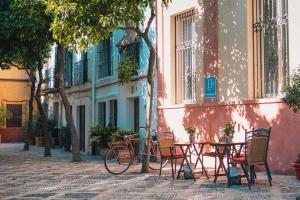
El Gòtic is the heart of Barcelona’s Old City. The Gothic Quarter, or Barri Gòtic, is a charming district of narrow medieval alleyways packed with fashionable bars, pubs and Catalan restaurants. The churches and cathedrals you will find nestled among the ancient buildings will take your breath away. The best recommendation we can make when visiting this neighbourhood is to let yourself be guided by its streets, improvising your stroll. Start by walking down La Rambla, beautiful and bustling, then lose yourself in the medieval alleyways and squares of the old quarter. To admire the city’s architecture, make your way to Plaça de Sant Jaume and visit the two government buildings: the Renaissance palace of the Generalitat and the Neoclassical façade of the Ajuntament. These are the must-see spots in the Gothic Quarter, one of the most important neighbourhoods of Barcelona:
- Barcelona Cathedral (la Seu) and the Diocesan Museum
- Plaça del Rei
- Plaça Sant Jaume and the City Hall
- The Bishop’s Bridge
- Santa Maria del Pi Cathedral and its square
- The Jewish Quarter
The Eixample
This district, geometrically laid out in a grid pattern, is the most central in the city and the one that concentrates the greatest number of monuments and points of interest, as well as being the commercial area par excellence. Leaving the historic district behind, the narrow labyrinthine streets give way to the Eixample’s wide, grid-like avenues. In 1855, Barcelona City Council opened a competition for an urban expansion project to meet the growing demand for housing, as the city was desperately in need of room to grow. The central government imposed the plan of Ildefonso Cerdà, which envisaged a regular grid scheme of square city blocks.
The Eixample is renowned for being one of Barcelona’s most dynamic districts. Three of Barcelona’s most important thoroughfares pass through it: the Passeig de Gràcia, the Gran Via and the Avinguda Diagonal. This neighbourhood is home to many of the city’s most important attractions, including the Sagrada Família, Casa Batlló and La Pedrera.
Montjuïc
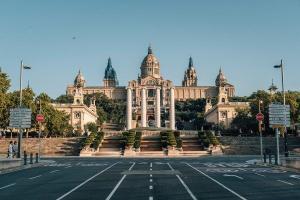
The hill of Montjuïc deserves a visit on your school trip. It is full of fountains, parks and gardens, making it the perfect place to go for a picnic. Here you will also find the Fundació Joan Miró, which is impressive both for its building and its collection. In addition, on Montjuïc you will discover the Magic Fountain, which puts on evening shows of lights and music during the high season. The picturesque Montjuïc is characterised by the fabulous views over the city that you get when you climb to the top of the hill.
Used since antiquity as a military lookout post, Montjuïc is the only significant elevated point in Barcelona besides the Tibidabo. The works carried out for the 1929 Universal Exposition and the 1992 Olympic Games have made Montjuïc a very interesting and well-rounded area for a worthwhile cultural visit on a school trip.
- The Magic Fountain of Montjuïc.
- Montjuïc Castle.
- Poble Espanyol
- Montjuïc Olympic Ring.
- National Museum of Art of Catalonia.
- Fundació Joan Miró
- Botanical Garden
El Born
El Born is one of the areas with the greatest range of leisure and culture in the city: architecture, gastronomy, art, fashion, dining, and more. Its distinctiveness lies in its cobbled streets, where medieval structures can still be felt, in perfect balance with hundreds of alternative and fashionable shops and businesses. Simply strolling through its streets is in itself one of the great attractions of the city, taking in its vintage clothing shops and tapas bars. One of the most authentic corners of the neighbourhood is the Mercat de Santa Caterina, spread over three floors and retaining its original charm. Here is a brief list of the places you should visit when passing through one of the most important neighbourhoods of Barcelona:
- Palau de la Música Catalana
- Mercat de Santa Caterina
- Museu Picasso
- El Born Market, now a Cultural Centre
- Basílica de Santa Maria del Mar
- Church and Plaça de Sant Pere
Furthermore, if you continue walking along Sant Pere you will reach the Arc de Triomf of Barcelona and its beautiful Parc de la Ciutadella, where the school group can stroll, rest during their free time and enjoy an impromptu little picnic.
El Raval
El Raval is an interesting and exciting area of Barcelona. This multicultural neighbourhood has a character all of its own, with food shops of every kind, traditional bars and numerous squares that make it a must-visit area. It is a neighbourhood full of life, both by day and by night. Here, let yourself be carried along by its vitality and its mix of cultures, and immerse yourself in its atmosphere until you feel part of it. Here are two of Barcelona’s most famous markets: La Boqueria and the Mercat de Sant Antoni. The first is far more touristy and photogenic, and the second much more local, but both have their own personality and authenticity. Places not to be missed in this truly authentic neighbourhood:
- Mercat de la Boqueria
- Mercat de Sant Antoni
- Rambla del Raval
- MACBA and CCCB
- Gran Teatre del Liceu
- Former Hospital de la Santa Creu
- Maritime Museum
- Columbus Monument
The Gràcia Neighbourhood
La Vila de Gràcia is one of Barcelona’s most popular and lively neighbourhoods, a hub of leisure, culture and gastronomy. In its origins, Gràcia was an independent village until the end of the nineteenth century, and even today its community remains close-knit and small, with a great deal of character. With narrow streets and little traffic, Gràcia has the feel of a small village. The neighbourhood is characterised by its many squares filled with terraces and a great atmosphere, alongside its local markets and all manner of independent shops.
- Plaça del Sol
- Casa Vicens
- Park Güell
- Plaça de la Vila de Gràcia
La Barceloneta
In 1754, fishermen began to settle in this part of the city owing to its proximity to the sea, forming what is now the neighbourhood of La Barceloneta. Despite taking on a more modern appearance, La Barceloneta still retains its special, intimate charm. The streets of La Barceloneta are very pleasant and distinctive: narrow alleyways full of old buildings, churches and some establishments whose décor has been preserved for nearly 200 years. These are the main points of interest in the area:
- Torre de les Aigües
- Hotel W Viewpoint on the beach
- Port Vell
- Museum of the History of Catalonia
- Maremagnum
- Barceloneta Beach
From Barceloneta Beach it is possible to take the cable car up to the Mirador de Miramar and enjoy views of the port.
Practical guide to organising your school trip to Barcelona
Barcelona is a city that must be visited at least once in a lifetime. Do you want to know everything about this city so you do not miss a thing on your trip? We reveal the best neighbourhoods, share its secrets and encourage you to live the complete experience on your school trip to Barcelona. Here is everything you need to know:
- How to organise your school trip to Barcelona
- The most important neighbourhoods of Barcelona
- Activities and excursions on your school trip to Barcelona
- Why visit Barcelona on your school trip?
- 15 experiences to have on your school trip to Barcelona
For more information about all the school trips to Barcelona that we organise at Natuaventura, write to us at info@natuaventura.com or call 91 714 06 36.