
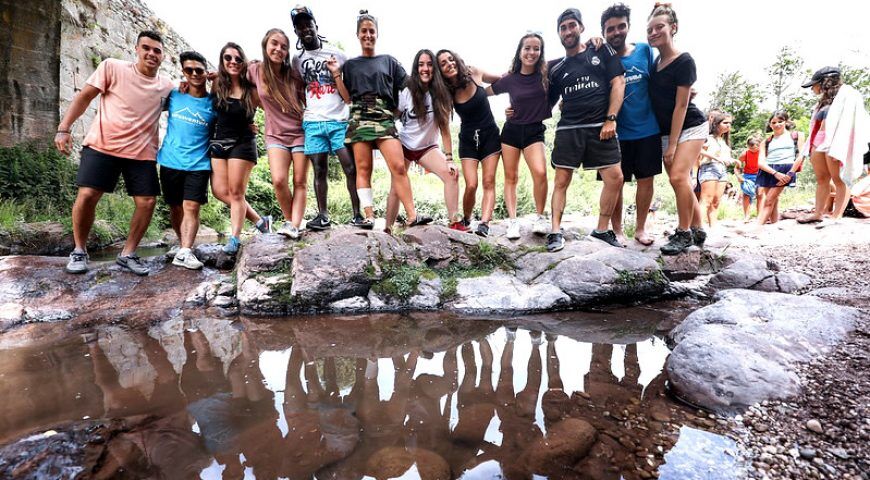
An eco-friendly camp is not simply one that takes place in the countryside: it is one that cares for the environment in which it operates, manages its waste, feeds participants with local produce and teaches them to leave the place better than they found it. In this article we look at what makes a camp genuinely eco-conscious and how this is reflected in the Natuaventura catalogue.
What defines an eco-friendly camp
Location in a protected environment
Natural parks, mountain ranges, purpose-built facilities for camps. Not improvising on the landscape, but integrating into it.
Waste management
Waste separation in the dining room and communal areas, minimising single-use plastics, complete removal of all rubbish after every bivouac or outing.
Cooking with local produce
In-house kitchen at the facility, home-cooked food and menus using produce from the surrounding area. Four meals a day (breakfast, lunch, afternoon snack, dinner) with menus adapted for allergies.
Environmental education
Clear rules from day one about wildlife, flora, water and waste. Learning by doing: hikes, swimming and excursions as living classrooms.
Catalogue camps in eco-conscious settings
Sierra de Gredos
- Gredos Multi-Adventure: municipal facility in Hoyos del Collado, tent accommodation, covered outdoor dining area, bivouac.
- Navarredonda: Nature Classroom adjacent to Navagredos campsite, swimming in the natural pools of the River Tormes.
- Navatormes English Camp: tipis alongside the River Tormes, purpose-built municipal facility for camps.
Other settings
- Cuenca Multi-Adventure: Alta-Lai Hostel in Casillas de Ranera, “we do not share facilities”, on-site swimming pools.
- Madrid Multi-Adventure: Albergue Sierra Norte, 20,000 m² of fenced woodland, renovated in 2013.
- Finca Daroca: close to the Parque Natural de la Font Roja and the Sierra de Mariola, in Ibi (Alicante).
How sustainability is lived day to day
In-house kitchen dining room: reduces transport and packaging, allows for adapted menus and minimises food waste.
Individual showers with responsible use: water is an explicit topic at mountain camps, especially in summer. Quick showers and turning off the tap are actively practised.
Bivouac and hikes with leave-no-trace principles: zero waste goes out. Whatever enters the mountain comes back out.
Mobiles collected on arrival: fewer screens, more environment. They are returned for calls home every 3–4 days, maintaining family contact without compromising immersion.
Social-media diary for families: reduces the need for individual photos and videos and centralises updates without overwhelming participants.
Environmental education as a habit
An eco-friendly camp does not produce environmentalists in a week, but it does sow everyday habits: separating waste without thinking, not leaving taps running, picking up litter even if it is not yours, respecting wildlife and footpaths. Families often report that these habits come home with the child.
Frequently asked questions
Is “eco-friendly” the same as “in nature”?
Not quite. Being in nature is the first step, but an eco-friendly camp adds active management of resources (water, energy, waste) and explicit environmental education.
What happens with plastic at the camp?
It is minimised wherever possible: reusable bottles instead of single-use ones, reusable crockery, removal of wrappers on hikes and bivouacs. The in-house kitchen also helps reduce individual packaging.
Are there zero-impact camps?
“Zero impact” is an aim rather than an absolute reality. But purpose-built municipal facilities for camps tend to integrate better into the environment than improvising on virgin landscape.
How does this work alongside multi-adventure activities?
Multi-adventure activities (climbing, archery, ropes course) take place on the camp’s own infrastructure. Hikes and river swimming are done with clear responsible-use guidelines.
What about the carbon footprint of travel?
The coach service from Madrid (Civitas Metropolitano) and Las Rozas (Navalcarbón), and even from Burgos for Santander, groups many families into a single journey. That is a smaller footprint than every family driving separately.
Summer in nature, with a conscience
Discover Natuaventura’s camps in natural parks, mountain ranges and nature classrooms with an in-house kitchen and environmental education.
We organise trips for primary, secondary and high school
School Trips
across Spain
alicante madrid barcelona more destinationsCamps from 6 to 17 years old, in different regions of Spain: Alicante, Madrid, Ávila, Cantabria and Cuenca.
summer camps
2026
multiadventure surf english immersion